Monday, August 29, 2016
Pequea Valley: A Little About My Student Teaching Placement
Hey Folks! I wanted to share with you a little bit about where I will be student teaching. This small town Wisconsin girl will be student teaching at Pequea Valley High School located in Kinzers, PA. I may be biased, but I think it's pretty awesome program. Check it out!

Sunday, August 28, 2016
#AEE412 Weekly Reading 1: It's a Process.
Darren Stoub, Andrea Kolb, Dave Mulder, Daniel Foster, Ryan Holle, John Rash.. the list could go on and on. The list of effective teachers I have had. But they didn't just end up that way. After completing my first week of senior year, the methods and capstone semester of our program, my biggest take away is: it's a process. Dr. Dan Tobin said this to me countless times last semester when I missed a few deadlines, came into his office stressed out beyond belief and knowing that I missed the boat on how I was expected to perform. See this whole performance vs. process thing has a been a long time struggle for me. Since I can remember my grandfather and aunt have set up a rewards system for good grades, and I always strived to meet it. Then I got that C in a college class and calling home was hard, I felt ashamed. But guess what I learned a lot through that process even though the performance wasn't what I thought it would be. It's the process that matters, so here is to the process of becoming a better teacher, and as Harry Wong, stated, "the best students are the best teachers."
This weeks weekly reading brought three big ideas to mind for me as I reflect on them and pull them all together.
1. Teaching is a science and craft, and still, not for the faint of heart.
Professor Mulder always told us teaching was not for the faint of heart, and I will always remember that. I believe it is a high calling, a passion and even scriptural. After doing some deeper reading though, it doesn't simply come naturally some dispositions might, but yet again, it is a process- a science that can be worked on continually. Wong states that it is a "highly skilled craft" and Paul Vaughn states it's a science because "it implies that good teaching is possible by closely following rigorous laws that yield high predictability and control." This means the “I’m not good at this” probably won’t fly this semester or from here on out. The idea that teaching is a science, something I can continue to try to improve upon, follow step by step tasks to learn, rather than an art that is finished and complete is refreshing, but also intimidating. It requires a lot of work- but work that is worth it, because students are worth it, those that I will student teach and those that will be in my classroom some day, buckle up kids.
Clarity is a much more clear and concise way to some this statement above, but it is how I think about a few of the concepts presented in our readings. Clarity, task oriented, a business like approach, opportunity to learn, along with learning objectives and modalities can be boiled down to creating the perfect package or present for students. Just like a present or a package, creating this clarity is really about putting a framework and structure together to help students learn. It is a thoughtful and thought out, wrapped and addressed to give students the opportunity to learn. The catch is that this all falls on the teacher, learning about my students and community will play into creating this package. Additionally, there is a long list of skills that I need to develop in order to create this package- learning objectives, effectively using Bloom's taxonomy and much more. I think most importantly providing clear examples, procedure and structures for students helps reduce some of that anxiety for them as they dive into the true gift inside of agricultural education and all it entails.
2. Use the right size box, wrap it in nice paper, and don't forget the bow.
 |
| Agricultural Education Magazine |
3. Be positive, and remind yourself and your students to get back up and try again.
These readings all hit on the idea of positive reinforcement and enthusiasm. In my mind these go hand in hand. The research shows that positive reinforcement is more effective to student growth and learning than criticism, which I would agree with, yet sometimes I think I tend to give and receive more criticism than I probably should. (This is something I want to be more aware of). I think the really important thing to think about with positive reinforcement though is where and what are we giving this reinforcement, on a performance or a process? We talked in class the other day about always praising students for the performance and forgetting about the process in between, but if we forget that process in between than what message does that send to students? Then again our system is set up for performance- so how do we balance this. In part positive reinforcement, but this is still something I want to continue to discuss and learn more about, and be aware of when I am in the classroom next semester.
In it all, if there is one thing I can commit 100% to that we read about this week it is this quote: "If you fill your team with positive energy and radiate that energy with a smile or boisterous laugh, your team will succeed." - Nevin & Knoblock
Yours in laugh through it all, even when I don't like the process (you may have to remind me of this.)
References:
Wong, H. Wong, R. (2004). The first days of school: how to be an effective teacher. Harry K. Wong Publications.
Agricultural Education Magazine. (2005). Volume 77. Issue 55.
Vaugh, Paul. (n.d.) Efective teaching: notes for the beginning teacher.
Saturday, August 27, 2016
SAE Visits: They Really are Plain & Fancy!
"Is it Supervised? Its it Agricultural? Is it an Experience?" These were the three questions Mr. Masser asked his 7th period class on Friday. I sat in the back and participated right along with the Agricultural Biology class, full of wide eyed sophomore that for the first time were being introduced to the heart of agricultural education. At Pequea Valley every sophomore takes agricultural biology along with their traditional biology class, giving Mr. Masser & Mrs. VanSant (and myself!) the opportunity to have them ALL in class. What was neat about the three questions was that after school we were going to visit two students Supervised Agricultural Experience Projects.
What is and SAE? These experiences are many times outside of the classroom that allow students the opportunity for individual and specialized experiences in agriculture, and allows the teachers to visit and help students expand content knowledge and set goals for the future.
After class we drove down the road to Plain & Fancy, an agricultural tourism destination located in the heart of Amish County Pennsylvania in Bird in Hand. This SAE was started on the part of Plain & Fancy that was looking for two students to help take care of their tourist garden. Mr. Masser & Mrs. VanSant then had an application process and Ryan and Noah are both working at Plain & Fancy.
The gentlemen started majority of their crops by seed, they did buy their sweet potatoes from another local business, but otherwise started most by seed. They gave us a tour, shared what they had recently harvested and what they were working on before we arrived. They said most of the produce is used in the Plain & Fancy kitchen. Mr. Masser asked a lot of questions about the progress they have had and what their supervisor was looking for them to plant after certain produce was harvested. We asked about their challenges and their joys, and with no surprise to us, they enjoyed most working together! What is more impressive is neither of them had really done much gardening before starting this project. Their challenges included some pest problems, which when asked they mentioned they did do some spraying but when it came to their cucumbers they didn't know what to do. It was really neat to watch Mr. Masser ask them some very specific questions to help them learn about the mildew problems they were having and why the cucumbers were not doing well, drawing on his personal content knowledge. This allowed me to see the real teaching opportunities that SAEs can bring to students.
Ryan and Noah shared the process they have gone through with the project. When it is a tourism location there are expectations and desires the location and supervisors have that may have been different than their original plans, but both of them were very calm and have adapted very well to the companies desires. They have also had very open communication with them about their school schedule and how much time they can commit now that school has started, which was very responsible of them to think about. While we were their looking around we were able to watch them interact with their supervisor, in a professional way. The communication with the location is only part of how they have grown in communication as they have also talked to various tourists as they walk through the gardens, providing a unique agricultural literacy opportunity for both parties.
As we ended the visit with a potato and a few carrots, fruits (or should I say vegetables) of their labor! Mr. Masser & Mrs. VanSant reminded them to update AET and about some of the opportunities they may have to apply for awards or scholarships. I am excited for continued opportunities to learn from students, Mr. Masser and Mrs. VanS
ant as we do other visits and restructure some SAE opportunities for students. This part of the three circle model really is essential. SAEs not only expand content knowledge for students but provide career and relational skills preparing them to be tomorrows leaders. I kind of like Lancaster county, can't wait to visit again!
 |
| Checking out some of the produce |
What is and SAE? These experiences are many times outside of the classroom that allow students the opportunity for individual and specialized experiences in agriculture, and allows the teachers to visit and help students expand content knowledge and set goals for the future.
After class we drove down the road to Plain & Fancy, an agricultural tourism destination located in the heart of Amish County Pennsylvania in Bird in Hand. This SAE was started on the part of Plain & Fancy that was looking for two students to help take care of their tourist garden. Mr. Masser & Mrs. VanSant then had an application process and Ryan and Noah are both working at Plain & Fancy.
The gentlemen started majority of their crops by seed, they did buy their sweet potatoes from another local business, but otherwise started most by seed. They gave us a tour, shared what they had recently harvested and what they were working on before we arrived. They said most of the produce is used in the Plain & Fancy kitchen. Mr. Masser asked a lot of questions about the progress they have had and what their supervisor was looking for them to plant after certain produce was harvested. We asked about their challenges and their joys, and with no surprise to us, they enjoyed most working together! What is more impressive is neither of them had really done much gardening before starting this project. Their challenges included some pest problems, which when asked they mentioned they did do some spraying but when it came to their cucumbers they didn't know what to do. It was really neat to watch Mr. Masser ask them some very specific questions to help them learn about the mildew problems they were having and why the cucumbers were not doing well, drawing on his personal content knowledge. This allowed me to see the real teaching opportunities that SAEs can bring to students.
 |
| Mr. Masser asked them to take a picture of this pest and see if they could look it up. |
Ryan and Noah shared the process they have gone through with the project. When it is a tourism location there are expectations and desires the location and supervisors have that may have been different than their original plans, but both of them were very calm and have adapted very well to the companies desires. They have also had very open communication with them about their school schedule and how much time they can commit now that school has started, which was very responsible of them to think about. While we were their looking around we were able to watch them interact with their supervisor, in a professional way. The communication with the location is only part of how they have grown in communication as they have also talked to various tourists as they walk through the gardens, providing a unique agricultural literacy opportunity for both parties.

As we ended the visit with a potato and a few carrots, fruits (or should I say vegetables) of their labor! Mr. Masser & Mrs. VanSant reminded them to update AET and about some of the opportunities they may have to apply for awards or scholarships. I am excited for continued opportunities to learn from students, Mr. Masser and Mrs. VanS
ant as we do other visits and restructure some SAE opportunities for students. This part of the three circle model really is essential. SAEs not only expand content knowledge for students but provide career and relational skills preparing them to be tomorrows leaders. I kind of like Lancaster county, can't wait to visit again!
 |
| I will forever be shorter than students..Thanks for the visit! |
Thursday, August 25, 2016
AEE412 Lab 1: Reflective Teaching Lesson
This week we participated in our first teaching lab, but we did things a little differently. We were paired together, and one teammate was responsible for teaching the lesson and the other was responsible for coaching. This was interesting and challenging because I so badly wanted to teach and try a lesson, but I know sometimes it's good to sit back and take a different role.
Our Task:
- Teach a lesson/Collaborate with your coaching partner
Our Lesson: (Evelyn's Lesson!)
- Teach students a new language (hieroglyphics), and try to have as many students as possible to use the new hieroglyphic language to translate a paragraph.
The paragraph that the students had to translate was all about what it takes to learn how to read, or understand a language. So yes, the lesson itself made no sense, but with context, it does. "Contextual learning helps student's process new information that is given to them in a way that makes sense to them in their own world of memory, experience and response (Parnell, 1995). This 'frame of reference' and setting the context was necessary in these lessons. Before teaching we learned all about the content of our lesson, but forgot about the context part until we got to class. We talked it over and then she added it in. The context is extremely important.
Again, this was our first lab and with that come fears, "what about this", "should I try this", "what if I fail?". But isn't that what it is about? Try something, then unpack it and see what went well, see what can be improved upon? Feedback is sometimes an uncomfortable thing, but there is no growth in a comfort zone and no comfort in a growth zone, and I know this class will always be a growth zone, even when I am not the one teaching.
Again, this was our first lab and with that come fears, "what about this", "should I try this", "what if I fail?". But isn't that what it is about? Try something, then unpack it and see what went well, see what can be improved upon? Feedback is sometimes an uncomfortable thing, but there is no growth in a comfort zone and no comfort in a growth zone, and I know this class will always be a growth zone, even when I am not the one teaching.
After working through the first lab and working through the first week of classes there are some things I am looking forward to diving into...allow me to explain.
1. Differentiated/Individual Instruction- We all come to the table with different experiences and abilities, how do we share in that and all grow? More than that, how do I do this for my students- teach to the mass, yet teach to the individuals?
2. How do I manage my time yet still meet the need of my desire for more? I leave wanting more, more time, more information, and a desire to ask more questions, or discuss more. Yet I have an entire 'To-Do' List to tackle. How do I balance this?
3. Feedback. We were asked to capture down feedback and a peer in lab asked me after for some feedback. But what constitutes as good feedback for teaching? I am looking forward to learning are the things that I question or that bother me, do they matter? Or are they the small things? And then how do I take and implement the feedback I will receive.
Yours on the road to becoming Ms.Hack.
2. How do I manage my time yet still meet the need of my desire for more? I leave wanting more, more time, more information, and a desire to ask more questions, or discuss more. Yet I have an entire 'To-Do' List to tackle. How do I balance this?
3. Feedback. We were asked to capture down feedback and a peer in lab asked me after for some feedback. But what constitutes as good feedback for teaching? I am looking forward to learning are the things that I question or that bother me, do they matter? Or are they the small things? And then how do I take and implement the feedback I will receive.
Overall it has been a great first week thus far, and I look forward to what is next as I prepare for those students next semester and beyond.
Wednesday, July 20, 2016
See Me After Class: The Things That Make Me Nervous. #psuaged17
“15% of new teachers
don’t make it to the second year. Nearly half quit within 5 years. “
Well that is encouraging…. It is not the first time I have
heard things like this. It is reality,
but it still makes me nervous. Can I
really do this? Do I have what it takes? I don’t think I am ready for this. The
list of questions go on and on. Although
I didn’t like it at times I know this book was good to paint a picture of
reality for me. This section of the book sparked a little more reflection for
me, personal and for my future students.
Four Quotes that Explain My Nerves:
1. “Students who don’t perform well on standardized tests constantly
get the message they are stupid.”
As a student I didn’t like these tests, and I know my
students will not either. These tests will create challenges for
students that fail them and even the ones that do well on them. It will also create challenges for me as I
try to teach and prepare my students for these tests. It also brings into conversation what tests
and grades are meant for what do they actually reflect? I think a variety of people would give
different answers- are they to reflect effort? Or knowledge of the
material? Grades are necessary in a
school system, but I don’t always think grades and learning are synonyms. But at the end of the day no matter the
comments I leave or the feedback I offer or how much I reward effort, a college
or job is going to look at students transcripts, not my comments whether I find
that fair or not.
2. “I knew I needed to work with him individually, but with 33 other students
I often overlooked him.”
This specific story was about an ESL student. As a language learner of Spanish, a past
tutor of an ESL student and a facilitator of ESL students this one hits home
and I recently saw the reality of it. Recently
I trained a team of students who have had English since kindergarten, but it
was still their second language. As I
worked through the sessions I continued to see the looks of confusion, I
switched back and forth, allowed them to use English or Spanish, but I still felt
I could not provide everything they needed to be as successful in the same way
I had other students I trained this summer. One student in particular was always
shy and nervous and frequently confused – when I waited for them to complete a
task I realized how easy it is to overlook these students. We have deadlines, more tasks to be done and
expectations we have to meet and it is easier to speed through it, and hope
they received half of what you wanted them to.
Sure I took a class about this, and I have a few resources and Spanish
in my back pocket, but providing assistances to struggling students ESL or not
will always be a challenge and I will probably never be satisfied- just as this
teacher shared in See Me After Class.
3. “Did you see me mom? I
hadn’t. I had been so busy grading that I missed his big moment.” And “No sane person would want to date them.”
No I am not in the classroom yet. No I am nowhere near
having children, but yes I do worry about things like this. Because the desire of my heart is to be
really great teacher, but also to be a great wife and mom someday- I can’t help
but think of these things, and I think it is a valid concern. Whenever a veteran teacher shares with our
classes I ask them: “How do you do
it?” How have you stayed in the
classroom for 20 plus years and been a wife and a mother? And invested in more
than your classroom? I am not sure we will ever get a clear answer
or method to this but I did appreciate that one teacher shared in the book to
go home, leave at a certain time and leave things at school to hold yourself
accountable. She felt later in life she
was still a successful teacher. Elden
offered ways to make grading papers more manageable by setting expectations for
yourself, and for your students. I liked her idea of using rubrics and
essentially beginning with the end in mind.
I am looking forward to learning some of these tips and tricks from my
cooperating teachers.
4. “All teachers have bad days,. Rookies just have more of them…Helping
rookies is tough sometimes. They can be cocky, whiney, hardheaded, or all of
the above…
This one is for you Dr. Foster, Dr. Rice and Dr. Ewing and
Mr. Masser and Mrs. VanSant- I apologize in advance! But really this was really good for me to
hear. I realize that sometimes I will be
difficult and make you shake your head.
Thank you for being there and answering all the questions you have thus
far and the ones you will continue to answer.
I am looking forward to the next year spent learning from all of you,
but I am nervous too! I will try to
remember that it is a PROCESS and that I will “Slowly becoming a better teacher
in the process.”
Friday, July 15, 2016
See Me After Class: You're Being too Negative for this Optimist
The eternal optimist in me struggled a
little through this last section of my book. I think there is a reason it is
written for current teachers, specifically after the first 1-2 years of
teaching. I don’t have that reality yet, and in a year I may agree with most of
the things said, or at least experienced them.
In all honesty this book is not for those who are still wrestling with the
idea of teaching, but it is an honest book by honest teachers. It has given me things to think about that typically
I wouldn’t from little things like cell phone and late assignment policies to
negative teachers and administrators, this section covered it all. So once again- here is your
spark-notes-highlighted-version with reflections from Ms. Hack of “See Me After
Class” by Roxanna Elden.
My Underlines, Highlights & Questions:
"The heart of teaching
is forming relationships with students as we move them from point A to point
B."
I loved
this analogy. Working with FFA for the
last few years while in college we talk a lot about this, and the importance of
realizing that not every student moves directly from from point A to point
B. Every student will be different. Visiting Pequea Valley and doing some other facilitation
engagements I have realized that different students need different avenues to
get to point B, and it may take a few U-turns or even fender benders- but we
still need to get them to point B. Even
more how we get them there, Elden emphasis the importance of relationships, and
how they will look different with almost every student. As a learner myself I know I am extroverted
and not afraid to share responses and ask questions- but that is not what every
student is like. This challenges me to
think about how I have students share answers and discuss with their peers or
the class as a whole. Question and answer does not need to happen every time, and
I do not need to always call students out to share an answer- it is the easy
way, because then I know if my students have the ‘right answer’, but it does
not give them as much ownership over their learning or put them at the center-
it will require unique and new techniques, which I am excited to try out!
"Resist the urge to
single out good kids..." and don't give up on those nightmare kids."
Elden and
other teachers are really honest in this chapter- both about students and
teachers that make our jobs difficult, negative and those that make teacher
wonder why they decided to teach. It is easier it seems to focus on the “bad
kids” the ones that make you pull your hair out, but Elden also mentioned the
“good kids” and the difficulties that can follow them within school. This
section showed me the importance of looking at my students yes as a whole
class, but even more individually- because they will all have different
challenges and triumphs. It is about
balance- which I can’t even begin to imagine how difficult that will be with 100
students through a program in one day. Each of them or groups of them may need to be
challenged in different ways. Even though
it will be hard, I won’t let the challenging students or other teachers hate my
job. A statement that seems ridiculously
optimistic, but as someone who is really committed to having my own classroom
very soon I can’t help but be optimistic, it’s been a desire of my heart for
too long not to be a little optimistic.
"Students continue to
grow up when they leave us."
From cell
phone policies, late work to broken rules and the ‘how many times do I need to
tell you’ this is probably one of the most important things to remember. It is not all
on my shoulders, and the end of the year is not the true end for my
students or for me. I know I will have
the position, ability and desire to make a difference, but my students won’t
stop growing or learning after they walk out my door. But if they don’t grow or
learn between the times they walked in and walked out, I may have failed
somewhere along the line.
"A note about mentor teachers.."
Elden mentions some things to be aware of when working with our teacher mentors. Thankfully ours for this year were chosen carefully for each of us in our student teaching cohort- and in my opinion I was placed with some good ones!she warns about challenges that may arise for various reasons, but regardless I'm looking forward to being continually challenged Mr. Masser and Mrs. VanSant! And looking forward to hearing your thoughts on your first few years of teaching!
Tuesday, June 14, 2016
See Me After Class... Summer Class Reading Reflections #psuaged17
“Action without reflection is simply a waste of time.”
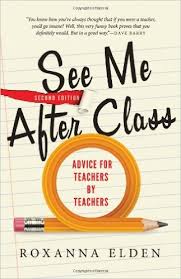
I have had countless mentors demonstrate and preach the importance of this. The thing is, they’re right. Reflection makes you that person that asks 20 questions, writes sloppy journals, and the person that reads book with a pen or a highlighter, underlining the things that stick out to reflect on later. So here it is, my “spark-notes-I-underlined-it-for-you-version” with added reflections of course, of the book See Me After Class- Advice from Teachers by Teachers by Roxanna Elden.
My Underlines and Highlights:
“Using other teachers’ ideas showed I couldn’t think of my own. I believed I was going above and beyond doing everything myself...my pride kept my students from learning…”
Ouch. I tend to want to do things my way, come up with new ways and add creativity to just about everything. I don’t have to create everything from scratch. I don’t have to recreate the wheel, and I shouldn’t. This is where you come in- all of you experienced teachers, help us, and remind us to share and collaborate. We have a lot to learn from you. Working as a facilitator I have realized the importance of starting with a solid base of curriculum, then I can add and tweak, but I will cheat my students out of good curriculum by not seeking out help from those around me. So here is me accepting your help (especially yours Mr. Masser and Mrs. VanSant).
“The first day of class should be the most structured day of the year, not the most exciting.”
I don’t ever remember being scared the first day of school- I was always excited. The 75th day on the other hand, that is a different story. But this time I am a little anxious. How is a first day supposed to work? How do I start in the middle of the year? What will my students think? What will Mr. Masser and Mrs. VanSant think? Even though they said not to worry about what they think- as long as I am working hard for the students, the first steps make me nervous. While I agree with Ms. Elden about the structure, I am stuck in the middle. Can’t building rapport and learning names and starting with some curriculum be exciting? How do you make it exciting?
“You became a teacher because you thought you were a certain type of person with specific things to offer your students. There will be days this month when you aren’t so sure.”
The chapter that this quote is from talked about the “mood swings” a teacher will go through in a year, and although it is helpful to know these feelings might happen, I feel the anxiety slowly creep up as I read. It is reality though- I may not see it yet, because I’m not there yet, but Mr. Masser reminded me sometimes teaching is less than glamorous (thanks every movie about teachers for making world think it is). It is hard, but I know it will be worth it. Although these warnings do cause a little hesitation, I think we should be a little scared of the things that matter right? Count me in.
Your goal is not to conceal your weaknesses or disguise them as strengths. It is to identify your true strengths and use them to reinforce potential weak spots.
What a relief! As someone who is a believer in Gallup’s Strengths Finder results, and that has trained student leaders on using their strengths I believe putting our strengths first is important. In fact in my one-on-one for one of my summer internships, we talked about teaching to students strengths and using our own strengths to do so. Elden added a list in the chapter to reflect upon, I outlined the following as my strengths and weaknesses, hoping those around me will hold me accountable to growing.
Strengths: Perseverance, Good people skills, work ethic, stage presence, positive attitude
Weaknesses: Knowledge of subject matter, knowledge of neighborhood, ability to stay calm and think clearly under stress, organization
Last but not least: It’s a process.
Subscribe to:
Posts (Atom)