Pages

Showing posts with label #psuaged17. Show all posts

Wednesday, November 16, 2016

Engines, Strokes & Parts: Micro Teaching at Juniata Valley

This week I completed my micro-teaching unit at Juniata Valley High School.  We completed three days of consecutive teaching of one class, on a specific content or subject area.  My class was first hour, and they were in their engines unit.  I am teaching an entire course called Power Technology at Pequea Valley, so this was a great introduction and practice to go into a full semester with small gas engines.  This class at Juniata Valley is putting together a 1948 Farmall Cub Tractor, that is in quite a few pieces, but the main engine block is together, which we referenced a lot.   Teaching this small group of students (6 high school gentlemen) for three days allowed me to reflect on a few things...


Plan so you can deviate from the plan. 

The second day I taught the basics of each stroke of the 4-stroke engine. In the class there was one gentleman that knew every stroke and has taken apart a number of 2 and 4 strokes, then there was one that this was his first time around it.  This dynamic is real and happens often.  When one of the students was struggling with the concept of the piston moving up and down the cylinder we stopped class went out to the shop and looked at the tractor engine and talked about the strokes, then we use a piston and plastic cylinder to demonstrate it it again int the classroom.  My original plan was that we were going to create a makeshift cylinder/piston/connecting rod to demonstrate the strokes, instead I adapted- we did something that worked better, and the repetition and practice helped.  


Structure, tradition and classroom practices take time.  

These three days were just a glimpse at what an entire semester might look like, but also the amount of work it will require.  Begining of class procedure such as bellwork, end of class traditions and other classroom management and practices are strucutres I want to create. These take time, and are dependent on the teacher and truly conditioning students to think and behave in these ways. 


Content knowledge is sometimes the biggest hurdle.  

The first time I touched a small gas engine was a year ago and then again in a course this year, but I am still pretty rusty, I just don't know all the ins and outs of parts and functions.  This is frustrating and sometimes creates lack of clarity and makes answering and asking questions more difficult.  This is an area I know I need to continue to grow in and develop, but I am starting to feel a little more confident.  


Technical vocabulary and content is challenging for many students.

I had one foreign exchange student in my class, where english was his second language.  Being a student that has learned a foreign language and have learned the theory on it all, but in practice it is more challenging, and I struggle with that.  It frustrates me that I didn't create more ways to assist him.  I felt like I did what I could for the amount of time I was here, but it is a part of my teaching that I will continue to grow in and it will be completely dependent on every student.  It wasn't only him, there were other students that strokes were new for, and adaptability was key here. 


General Gems: 


  • Adaptability
  • Hands-on Examples 
  • Energy Conversion Demonstration
  • Formative Assessment Reviews 
  • Enthusiasm

General Opportunities:

  • Content confidence 
  • Asking and answering quesitons
  • Clarity in explanations 
  • Structure in the lab

Learner Satisfaction: 

The forms below provide a little more insight on learner satisfaction.  I am a little concerned seeing the confidence in material one.  They were split, which is how they were in the class too.  I wish more of them were there day three to really go through things in more depth.  Differentiation is hard, and an area I want to continue to grow in.  Continuing to grow in formative assessment, unique repetition and engaging in material in different ways is key to this. 


Tuesday, November 15, 2016

LifeKnowledge: Teaching at Pequea Valley

Leadership Style Brainstorm
This past week I had the opportunity to teach my first lesson at my cooperating center, Pequea Valley High School.  Our task was to use LifeKnowledge lessons from National FFA, adapt them how we see fit, and teach in our cooperating center.  I chose to adapt a leadership and career lesson to focus on how career and leadership success are important in the agricultural industry.  Overall this was a great experience!  I enjoyed being at Pequea Valley, receiving feedback from students and Mr. Masser and starting the transition to student teaching.  There are a few realizations I had after this lesson, as well as some gems and opportunities to grow.  


Sharing leadership styles

Gems:

Engagement:
My lesson, attitude and energy was appropriate to engage both groups of students I taught.  I felt the mix of individual to group teaching techniques created a variety of ways for students to be engaged.  Students are all engaged differently and different levels.  Creating learning experiences that allow visual, auditory and kinesthetic modalities to be used increased this engagement.  I was able to use playdough to sculpt concepts, a powerpoint to engage them visually and a discussion/interview to engage auditory learners.  I was also engaged- with a positive attitude and interest in the topic at hand- this is essential, because if I am not excited about what I am teaching it, why am I teaching it? 


Growth:
I was lucky enough to teach this lesson twice with some time to think and debrief and observe Mr. Masser teach.   As I reflected in that time I thought of things to change, but I also was able to see how Mr. Masser facilitated some of his learning experiences.  Grouping students and asking them to obtain supplies was a struggle of mine but from the first to the second this was an improvement.  In the second class I could adapt with the size of the class and was more comfortable.  The comfort and confidence helped me to welcome questions. 

Opportunities: 

Directions:
Defining Leadership & Success
This has been on my opportunities list so many times.  I KNOW how to give good directions, but it is so difficult.  It is definitely improving, but it is something I need to grow in. Chunking them and visually posting them is helpful.  I think now I need to move students and then give them more directions.   I think this will become easier when I am more comfortable where I am as well.  

Voice & Management:
Classroom management is going to be a challenge for me,  it wasn't bad by any means- but it is an area I noticed I will have to work at. I can be stern and 'lay down the law' but my size and higher voice simply makes it more difficult.  One of my professors mentioned that my voice and hand motions sometimes can add to this challenge,  which is an area I can improve upon. Through this I also realized the importance of learning students names and building rapport with them.  Which leads me to....


I'm ready.

Interviews! (speed dating style)
I may not be 100% ready, qualified, or have all the experiences, knowledge and assignments I need yet...but I am ready for that classroom.  As I taught the lesson and managed the class, I wanted to know names, stories and quirks of the class, but I am still a visitor.  My half day at Pequea Valley built up my excitement for the spring! I couldn't be more excited to learn from and alongside Mr. Masser and Mrs. VanSant and all of our students.   

Being a Connected Educator: Twitter & Beyond


Our Twitter Chat:

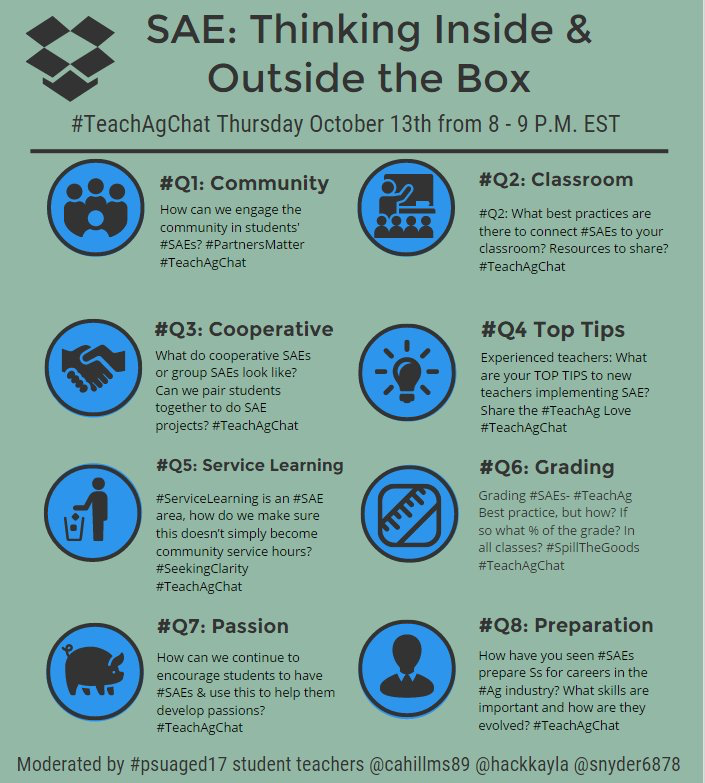
This semester my peers and I were tasked with creating a Twitter Chat to engage teachers, pre-service teachers, industry professionals and supporters of agricultural education.  Twitter chats are fast, informative and spark new ideas and if you scroll through your Twitter feed, chances are there is at least one you can find daily.  Our group chose to do our chat on Supervised Agricultural  Experiences or SAEs.  We chose it because we have a vested interested in it.  Our students will have SAEs and we wanted to hear from the experts about "SAE: Thinking Inside and Outside the Box."  The ideas and resources flowed in.   The chat brought many answers, and even more questions (which as a developing educator, I appreciate)! 

SAE Chat Highlights:


- Resources from current teachers in the field


- New thoughts and ideas of how to evaluate and take time for SAE

- Cool Success Stories from Ag Teachers


Being a Connected Educator: 

As I said Twitter chats are fast, and not always easy to catch up with, but they provide a unique opportunity to engage with agricultural educators from across the country.  As a pre-service teacher I value the contacts, ideas and questions that other educators provide, especially ones with more experience than I have.  Wherever I choose to teach, I know that I can still connect with these teachers- and if I am lucky run into them at National Convention!

Twitter and the Teach Ag Chat are important ways to be connected especially in our field, but they are only two ways.  I think blogging, other social media outlets and even community outlets show us how to be a connected educators as well.  Recently for class we read an article from Time Magazine, titled, Teen Depression and Anxiety: Why the Kids Are Not Alright.  The article dove into challenging topics of  overconsumption of social media, anxiety and even self harm- pressures on students that are sometimes created by social media.  Social media is an area of my job, life, and students life that I will NOT ignore, and I will CHOOSE to use in and outside of class, I have to relate to students where they are at.   So yes, I will continue to engage on social media, but I will also encourage students to use it wisely and be aware of the joys and challenges in can bring.  Being a connected educator is being that 'check up' and connected to what students might see, face or experience, but it is also connecting with the professionals in my career and networking to bring new ideas to students!

Sunday, October 30, 2016

The Unexpected Fits in Agriculture: Inquiry Based Instruction.

Who, What & Why:

Inquiry Cycle.
https://edis.ifas.ufl.edu/pdffiles/WC/WC07600.pdf
Cultivating curiosity is part of my teaching philosophy, but the more labs we have and the deeper into this teacher preparation program, the more difficult I realize it is.  Because it is not always how I was taught. I did have one great chemistry professor in college that used inquiry-based instruction, but it was challenging for me to learn that way at first.  I agree that when using inquiry, especially at first if students are unsure of it, I need to be honest myself as a teacher and my students that it involves the unexpected (Alberta Learning).  Even though it involves the unexpected, there are methods to make it happen and it is something students do not something that is done to them (Alberta Learning).  Because inquiry involves experiencing or experimenting with something, comparing it to past and future concepts, and an element of reflection or evaluation I think it is very similar to Kolb’s experiential model.  In agricultural education, we talk about Kolb’s model in regards to SAEs but I think it is also applicable in the classroom.  Students have concrete experiences, reflect on their observations, find abstract concepts, and experiment again in the classroom as well.  This is inquiry.  In addition to this concept, there were a few other concepts I took away from the readings. 

Kolb's Experiential Model
http://www.nwlink.com/~%E2%80%89donClark/hrd/styles/learning_styles.jpg


Stop Collaborate and Listen

Good inquiry requires collaboration, between students and others in the school.  Various articles stated that it is important to work with the science department to plan and implement some of the inquiry.  Being that much of agricultural education now is aligned with science standards this makes sense.  I have seen the importance of this collaboration in various locations.  It’s these types of collaborations that deepen student knowledge of the content and scientific process and continue to prepare them for college and careers. 


Failing to Prepare is Preparing to Fail

This quote could be the title of every blog I have written lately.  Inquiry is more of a ‘guide on the side’ pedagogy, versus a ‘sage on the stage’ but it requires a great deal of planning.  I also think it requires confidence and competence in the content area, and in the research skills to also discover answers as you guide students to do the same.  I know that this will require more front loaded work for me, but will be more beneficial for students in the end. 


Action without Reflection is a Waste of Time

I am a product of quality reflection and now understand the importance of implementing quality of reflection.  I think observations and evaluation are in essence reflection practices for science based concepts. The Alberta Education article shares the importance of reflection on the learning process itself as well.  Not only is it important to do reflection, through observations and evaluations, but it is also important to explicitly give student reflection prompts and ways inquiry connects to industry and college standards and practices. 

Inquiry Expects More

There are numerous articles, teachers and parents that I am sure we would say are expecting too much of students, and yes maybe in some ways we are as an entire system.  But I would also argue there are ways and occasions where it is important to expect more.  In Dr. Thoron & Dr. Myers (2014) research on inquiry based instruction he interviewed teachers and this quote resonated with me, “if my overall goal is to make sure students memorize something then we memorize it, if I want them to learn deeper knowledge I use inquiry and I assess them accordingly.” I couldn’t agree more, it expects them to be realistic and think deeper, and that is something we should expect.  Along with that various teachers comment on the evaluation and assessment of inquiry, and related it back to student being able to justify answers.  This is an essential skill, to be able to justify answers and findings, in any field we are in.  And if the vision of agricultural education is to encourage students to make a lifetime of informed choices in the global agricultural and food industry, then I think inquiry might be a great place to teach this. 


References:

Warner, A.J. & Myers, B.E. (2011) What inquiry-based instruction? Retrieved from https://edis.ifas.ufl.edu/pdffiles/WC/WC07500.pdf 

Warner, A.J. & Myers, B.E. (2014). Implementing inquiry-based teaching methods. Retrieved from https://edis.ifas.ufl.edu/pdffiles/WC/WC07600.pdf 

Alberta Learning. (2004) Focus on inquiry: a teacher’s guide to implementing inquiry-based learning. Retrieved from https://education.alberta.ca/media/313361/focusoninquiry.pdf 

Thoron, A.C., Myers, B.E., & Abrams, K. (2011). Inquiry-based instruction: How is it utilized accepted, and assessed in schools with national agriscience teacher ambassadors? Journal of Agriculture Education, 52(1), 96-106. DOI: 10.5032/jae.2011.01096 
Note: Retrieve online from http://files.eric.ed.gov/fulltext/EJ955679.pdf 


Monday, October 24, 2016

Unpacking the Jargon: Differentiation & Individualization

No...no...no...it is so much more!!
https://www.pinterest.com/pin/163044448982451076/
Both individual instruction methods and differentiation all put the learners needs and desires at the forefront of education.  This is where we become the guide on the side, versus the sage on the stage.  Even though we are more on the side when we use individual and differentiated techniques they arguably take more planning time.  The difference between individual techniques and differentiation is that differentiation always has the same rigor and expectations, (unless a student has an IEP) and differentiated selects from a variety of other techniques, and can be more on the spot.  For example, we can differentiate individualized instruction by using supervised study but giving the option for partner or individual option.  We can also do this with problem solving, providing the same problem but allowing for various solutions.  These three concepts of differentiation I think can be used with any form of instruction: readiness, choice and routines. 

Readiness.

The Edugains article we read defines differentiated instruction as: "effective instruction that is responsive to students’ readiness, interests and learning preferences."  Readiness is a concept that I have not explicitly thought of before.  Of course we think of readiness at the beginning of a new unit, but it can change from concept to concept.  We need to make sure students are ready for what is next content wise along with the format the learning will take place in.  


Choice.

Choice is essential for student ownership and interest in the classroom.  In order to give students choices,we have to help them with when and how to choose.  Teaching students about good choices and allowing them to reflect on those choices helps them to continue to make good choices.  Scaffolding smaller choices prepares students to make bigger and appropriate choices.  But it is extremely important that no matter what choice they make (in an assignment or project) they are held to the same expectations. 


Routines.

I used to hate routines, and sometimes I still do, but when it comes to learning a new task, or increasing productivity, routines are essential.  In the classroom these structures and routines take time.  In May I went to visit Pequea Valley and I was extremely impressed by the way all the students participated in lab, it was as if he didn't have to give instructions, students new the rules, format and what to do next.  Mr. Masser simply took notes on participation and behavior and gave students the supplies they needed.  When I asked him about it, he said it takes them time to get to that point, and students have to learn how to interact and participate in lab, these skills is taught heavily at the beginning of the semester.  Because this routine and system was set up, choices and differentiation in the lab procedures could be implemented- students could choose their own recipe and ingredients for a foods lab, but they still had to follow the same lab protocol and were evaluated the same.  


Sources:

Newcomb, L.H., McCracken, J.D., Warmbrod, J.R., & Whittington, M.S. (1993). Methods of teaching agriculture. Upper Saddle River, New Jersey: Pearson Prentice Hall.

EduGains. (2015). Reach every student through differentiated instruction. Retrieved from http://www.edugains.ca/resourcesDI/Brochures/DIBrochureOct08.pdf

Friday, October 14, 2016

Problem Solving Approach Attempt 1: Selective Breeding

I looked back at my reflection of my first day of school lab before writing this reflection and realized I felt the opposite.  After this lab, I didn't feel quite as good about it, but that is okay.  I realized a lot mid lesson and after the lesson from my peers, Dr. Rice and how I was processing during the lab.  I am starting to realize that if we are not conscious of what and how we are teaching, or in our planning, or even comfortable, we tend to revert to how we were taught or exactly what the plan says.  My lessons will be better if I continue to adapt, be open to curiosity and own up to new ideas and even mistakes. 

Gems: The things I and others felt I did well

Creativity & Review
I chose to start with a review for this lesson, which originally I had planned as an objective, but I think it could be easily used as an interest approach.  I chose to use our Ipads and phones to play the game heads up.  In this lab we only played (I pre-entered words) but I would ask students to write key terms, and then descriptions.  They would enter the words and keep the descriptions, then create competition to review.  This app does cost .99cents, and then .99cents for the 'Build Your Own Deck' but it's worth it! Students seemed to really like this.  The transition here was essential, and I felt I did an okay job at this, more directed questions could increase the connection, but I think it was a great review into the 'why' of selective breeding.  

Grouping & Expectations
In my last few lessons I was not clear about how I expected students to work in groups, I felt it was better in this lesson.  Because students were in two rows, this worked out a little easier.  Beyond the groups, the expectations were more clearly defined for this.  I posed a question to students about what partner work should look like.  We clarified that we can work together, but have to hand in our own paper, and work together.  When I noticed two students had split up the worksheet, I clarified that we are responsible for the material even if we split it up, so sharing it is necessary.    


Gems the students and my peers shared: 

  • Walking around and talking to students
  • Head's Up!
  • Topic was interesting
  • Worksheet was helpful 
  • Connecting with student experiences 


Opportunities: If you're not green, you're not growing. 

Clarity- Directions & Questioning 

I would love to say this soon be off the 'opportunities list' but it's going to take some time.  I think more directed, shorter, chunked directions are necessary.  Writing these out will help.  Also sharing the directions on the screen or on the worksheet again is necessary.  I wrote down some questions, but for my next lessons I need to think even more about questions, write down 10 even if I only ask 5, because quesitons are essential to transition, and more effective questions would have improved this lab even more.


Feeding Off Students

One of the students in lab brought up several good points, challenged the question and problem and continued to press into this.  In the moment, I chose to keep directing him to find 'positive and negative traits' those were the directions...but he brought up GREAT points! After this small struggle he mentioned it was 'stupid' which tied back to a conversation about expectations.  ALL of this could have been avoided and improved if I would have taken advantage of his curiosity and questions which would have made the problem and case study better and more realistic!  In hindsight I could have posed his questions to the class, asked him to provide a list of suggestions that were more realistic and economical to the rancher we were looking at.  It worries me that I say that my philosophy involves curiosity yet in the moment, I was not willing to deviate from my plan because of curiosity that was completely in line with what we were doing, he was problem solving!


Opportunities the Students and my peers shared:

  • Student behavior
  • Flaw in the scenario 
  • Question crafting
  • DIRECTIONS 

I learned so much from this lab, even though I didn't like that in the moment, I have lots of ideas of how to revise this and other problem solving lessons.  


Sunday, October 9, 2016

No Need for Anxiety: the Who, What , When and Why of Evaluation and Assessment

It is the thing that we tend to despise the most, but one of the things that is most necessary in education:  assessment and evaluation. This week’s readings focused on the who, what, when and why of assessment. 

Who: 

This is a perfect representation of how we can ensure
our assessments and evaluations are reliable and relevant.
http://www.ulm.edu/assessment/
We usually think of assessment and evaluation just being about students and grades, and it is, but it also is for teachers, schools and communities.  Evaluations help keep teachers and students accountable to their schools and communities. Grades are a specific way this is reported, but none the less, it is an important accountability piece.  These assessments also help us as teachers when we plan curriculum for a unit or a course, this backward planning will ensure that objectives are linked to assessment questions.  The various types of evaluations give students an opportunity to assess themselves on a project, lab or even correct written tests to anchor and re-evaluate learning. 

What:

“Assessment is used to evaluate the strengths and needs of learners, guide instruction, and measure progress and achievement” it is also “assessing what students have learned.”  Although these are the definitions of assessment, there are various methods to assess and evaluate student learning and performance. 
  • Pre-test/Needs Assessment- I am starting to realize this is essential.  If I don’t know where students are at before the next topic or unit, then I could be missing many of them.
  • Written Evaluations- These should be based off of course objectives. They can be multiple-choice, short answer, true-false and/or essay
  • Rubrics- Rubrics can be used in combination with many other assessment tools.  I will be using a rubric for my floriculture unit, as a project will be evaluated along with other portions of the assessment.  This is an area I look forward to exploring and trying as I student teach, but also finding ways to make it simple for grading is essential. 
  •  Task-Lists & Check Lists- I can see these being a large part of all of my labs.  In agricultural mechanics classes this is one of the best ways to evaluate students.  If this is combined with an end of unit or mid/end of course rubric or project evaluation, it would make it even more reliable of an assessment tool. 
  •  Self Assessments & Direct Observation- I combined these two because I like the idea of doing both.  I have seen Mr. Masser keep notes of how students are performing in lab as they go about their procedures, this is part of their grade.  Doing this, but also allowing for a short personal reflection and checklist.  This could help students see where behavior expectations

When:

One thing that stood out to me when reviewing when to assess and evaluate students was length of assessments.  The longer the test, specifically written test, the more comprehensive it is and it is typically more reliable.  Time between material and evaluation should also be taken into account.  If various forms of short quizzes are given throughout a unit, then a longer unit assessment is not necessary.  Lab and practicum evaluations should also be written so they are conscious of time that it will take to perform evaluations for each of the students.  One of the readings gave a suggestion to

Why:

Part of this is because it is required, but it is required for good reason, as long as it does what is supposed to do.  The why can be summed up in a few questions, which will help me self-check my assessment and evaluation methods.
  1. Is summative or formative assessment necessary at this point?
  2. Am I assessing what I want to assess? And how am I communicating that?
  3. Do my assessment or evaluation techniques provide answers to essential questions and objectives previously written and taught? 
  4. Can students demonstrate what they have learned?
  5. Is this appropriate for students abilities and academic and educational goals- and is it transparent? 
  6. Is this assessment realistic to what a student would do in a career setting? 
  7. Do specific students need accommodations or modifications?


Saturday, October 1, 2016

Problems & Projects: 10 Questions.

This weeks readings bring together what I really hope to bring to all of my classes.  We solve problems every day, some are just bigger or more complex or scientific than others.  Problem based learning is great, but as many of the readings alluded to, it is not the easiest to implement, stick with and keep realistic and relevant.   It requires an atmosphere that is encouraging and stretching, because it can be challenging for students that have simply been taught 'receive, remember, restate'. Project based and problem based learning cultivates curiosity. As I went through I started to make a mental checklist of the questions I need to ask myself to see if I am using problems based learning.  Here are 10 questions I want to ask myself as I plan units and lessons that involve problem based learning. 

1. Is this an authentic problem or project and is the context I am teaching it in or around realistic? 
With project based learning this could look like a project or an issue in the community and the it can be presented to a realistic audience. 

2. Have I scaffolded learning up to this point? 
Scaffolding is extremely important, depending on the types of problems students are being asked to solve, and the content they are being asked to apply.  I think problem solving needs to have a lot of scaffolding at first, and then supports can slowly be removed so students can make decisions of how they want to approach solving newer problems.  

3. Am I helping students define the goals and make mental models? 


4. Am I teaching for transfer? 
The problems I pose or projects I involve students on should tie to previous content and help them apply it.  They should be able to transfer these problem solving skills to other problems in the future. 

5. Are students actively learning, thinking and searching- and is this learning, thinking and searching stretching? 
In both problems and projects, students should be applying content not simply knowing it.  This requires 21st century skills in project based learning. 

6. Am I providing a way for students to reflect and evaluate the process? 
Action without reflection is simply a waste of time, this continues to ring true and takes us back to Kolb's model of experience and reflection once again. 

7. Am I assessing students and how?  
In project based learning, do I have another stakeholder assessing or giving feedback and if so why and how are they connected.

8. Are students asking and developing questions?
With problem based learning students may have more limited solutions, but in project based they should have an open ended driving question. 

9. Do students have a voice and choice?  
This involves responsibility, both in project based and problem solving.  This responsibility and clarity should be provided to students at the beginning. 

10. Is it interesting? 
Project and problem based learning should be interesting to students, yes it should have meaning and dive into significant content, but it should also be interesting.