Pages

Showing posts with label #teachag. Show all posts

Friday, July 15, 2016

See Me After Class: You're Being too Negative for this Optimist

The eternal optimist in me struggled a little through this last section of my book. I think there is a reason it is written for current teachers, specifically after the first 1-2 years of teaching. I don’t have that reality yet, and in a year I may agree with most of the things said, or at least experienced them.  In all honesty this book is not for those who are still wrestling with the idea of teaching, but it is an honest book by honest teachers.  It has given me things to think about that typically I wouldn’t from little things like cell phone and late assignment policies to negative teachers and administrators, this section covered it all.  So once again- here is your spark-notes-highlighted-version with reflections from Ms. Hack of “See Me After Class” by Roxanna Elden. 

My Underlines, Highlights & Questions:

"The heart of teaching is forming relationships with students as we move them from point A to point B." 

I loved this analogy.  Working with FFA for the last few years while in college we talk a lot about this, and the importance of realizing that not every student moves directly from from point A to point B.  Every student will be different.  Visiting Pequea Valley and doing some other facilitation engagements I have realized that different students need different avenues to get to point B, and it may take a few U-turns or even fender benders- but we still need to get them to point B.  Even more how we get them there, Elden emphasis the importance of relationships, and how they will look different with almost every student.  As a learner myself I know I am extroverted and not afraid to share responses and ask questions- but that is not what every student is like.  This challenges me to think about how I have students share answers and discuss with their peers or the class as a whole. Question and answer does not need to happen every time, and I do not need to always call students out to share an answer- it is the easy way, because then I know if my students have the ‘right answer’, but it does not give them as much ownership over their learning or put them at the center- it will require unique and new techniques, which I am excited to try out!


"Resist the urge to single out good kids..." and don't give up on those nightmare kids."

Elden and other teachers are really honest in this chapter- both about students and teachers that make our jobs difficult, negative and those that make teacher wonder why they decided to teach. It is easier it seems to focus on the “bad kids” the ones that make you pull your hair out, but Elden also mentioned the “good kids” and the difficulties that can follow them within school. This section showed me the importance of looking at my students yes as a whole class, but even more individually- because they will all have different challenges and triumphs.  It is about balance- which I can’t even begin to imagine how difficult that will be with 100 students through a program in one day.  Each of them or groups of them may need to be challenged in different ways.  Even though it will be hard, I won’t let the challenging students or other teachers hate my job.  A statement that seems ridiculously optimistic, but as someone who is really committed to having my own classroom very soon I can’t help but be optimistic, it’s been a desire of my heart for too long not to be a little optimistic.  

"Students continue to grow up when they leave us."

From cell phone policies, late work to broken rules and the ‘how many times do I need to tell you’ this is probably one of the most important things to remember.  It is not all on my shoulders, and the end of the year is not the true end for my students or for me.  I know I will have the position, ability and desire to make a difference, but my students won’t stop growing or learning after they walk out my door. But if they don’t grow or learn between the times they walked in and walked out, I may have failed somewhere along the line.  

"A note about mentor teachers.."

Elden mentions some things to be aware of when working with our teacher mentors. Thankfully ours for this year were chosen carefully for each of us in our student teaching cohort- and in my opinion I was placed with some good ones!she warns about challenges that may arise for various reasons, but regardless I'm looking forward to being continually challenged Mr. Masser and Mrs. VanSant!  And looking forward to hearing your thoughts on your first few years of teaching! 


Tuesday, June 14, 2016

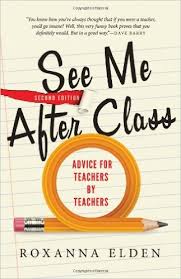
See Me After Class... Summer Class Reading Reflections #psuaged17


“Action without reflection is simply a waste of time.”

I have had countless mentors demonstrate and preach the importance of this. The thing is, they’re right.  Reflection makes you that person that asks 20 questions, writes sloppy journals, and the person that reads  book with a pen or a highlighter, underlining the things that stick out to reflect on later.  So here it is, my “spark-notes-I-underlined-it-for-you-version” with added reflections of course, of the book See Me After Class- Advice from Teachers by Teachers by Roxanna Elden.

My Underlines and Highlights:

“Using other teachers’ ideas showed I couldn’t think of my own. I believed I was going above and beyond doing everything myself...my pride kept my students from learning…”
Ouch.  I tend to want to do things my way, come up with new ways and add creativity to just about everything.  I don’t have to create everything from scratch.  I don’t have to recreate the wheel, and I shouldn’t.  This is where you come in- all of you experienced teachers, help us, and remind us to share and collaborate.  We have a lot to learn from you.  Working as a facilitator I have realized the importance of starting with a solid base of curriculum, then I can add and tweak, but I will cheat my students out of good curriculum by not seeking out help from those around me. So here is me accepting your help (especially yours Mr. Masser and Mrs. VanSant).
“The first day of class should be the most structured day of the year, not the most exciting.”


I don’t ever remember being scared the first day of school- I was always excited.  The 75th day on the other hand, that is a different story.  But this time I am a little anxious.  How is a first day supposed to work? How do I start in the middle of the year?  What will my students think?  What will Mr. Masser and Mrs. VanSant think? Even though they said not to worry about what they think- as long as I am working hard for the students, the first steps make me nervous.  While I agree with Ms. Elden about the structure, I am stuck in the middle. Can’t building rapport and learning names and starting with some curriculum be exciting?  How do you make it exciting?
“You became a teacher because you thought you were a certain type of person with specific things to offer your students.  There will be days this month when you aren’t so sure.”
The chapter that this quote is from talked about the “mood swings” a teacher will go through in a year, and although it is helpful to know these feelings might happen, I feel the anxiety slowly creep up as I read.  It is reality though- I may not see it yet, because I’m not there yet, but Mr. Masser reminded me sometimes teaching is less than glamorous (thanks every movie about teachers for making world think it is). It is hard, but I know it will be worth it.   Although these warnings do cause a little hesitation, I think we should be a little scared of the things that matter right? Count me in.


Your goal is not to conceal your weaknesses or disguise them as strengths.  It is to identify your true strengths and use them to reinforce potential weak spots.
What a relief!  As someone who is a believer in Gallup’s Strengths Finder results, and that has trained student leaders on using their strengths I believe putting our strengths first is important.   In fact in my one-on-one for one of my summer internships, we talked about teaching to students strengths and using our own strengths to do so.  Elden added a list in the chapter to reflect upon, I outlined the following as my strengths and weaknesses, hoping those around me will hold me accountable to growing.
Strengths: Perseverance, Good people skills, work ethic, stage presence, positive attitude
Weaknesses: Knowledge of subject matter, knowledge of neighborhood, ability to stay calm and think clearly under stress, organization
Last but not least: It’s a process.  

Teaching and learning are both long and good processes, and I am just beginning that. Elden is not alone in thinking this, it is the feeling I got from the book and from my cooperating teachers. Mr. Masser said “part of the learning process is to fail sometimes, which is hard to hear at first. Sometimes we learn more from lessons that go wrong, than from lessons that go right.” So here is to learning through the process, even if my first day fails, my weaknesses show, and on the days I just want to pretend I chose a different major. As a professor once told me... Teaching is not for the faint of heart.